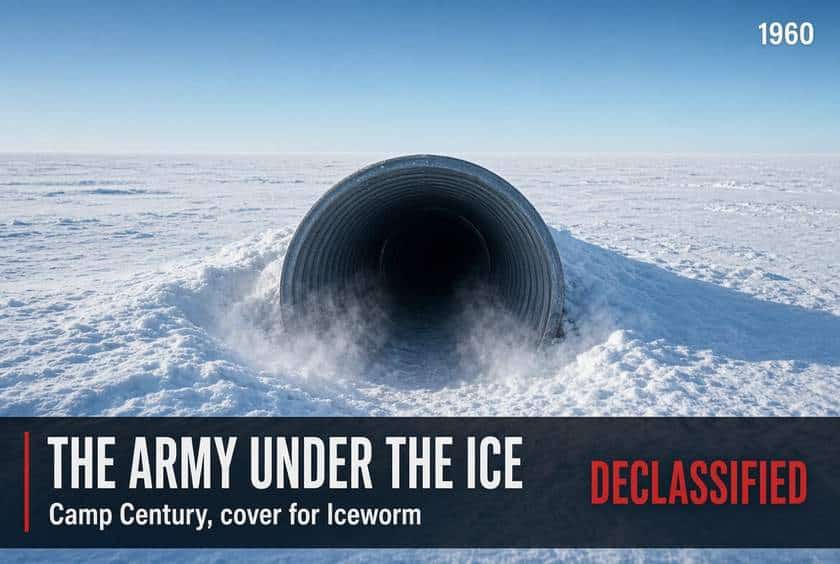
Camp Century was a U.S. Army research station cut into the Greenland ice sheet about 138 miles east of the Army’s Camp Tuto, near Thule Air Base, built between June 1959 and October 1960 and powered for most of its first three years by a portable nuclear reactor (Clark 1965, pp. 25–31). It was presented publicly as a test of Arctic construction and nuclear power. It also served as the proving ground for Project Iceworm, a 1960 Army concept for basing up to 600 medium-range nuclear missiles in tunnels under the ice, which was never built (Amstrup 1997, p. 217; Colgan et al. 2016, p. 1). The missile plan stayed classified until the Danish government’s historical inquiry of 1995–1997.
The 1951 agreement and the question of nuclear weapons
The legal basis for U.S. installations in Greenland is the Defense of Greenland Agreement signed by the United States and Denmark on April 27, 1951. It gave the United States broad rights within designated defense areas. Its Article XI provides that property brought in by the United States remains U.S. property and “may be removed from Greenland free of any restriction, or disposed of in Greenland by the Government of the United States of America after consultation with the Danish authorities” (Defense of Greenland Agreement, 1951, Art. XI).
The agreement did not settle whether the United States could store nuclear weapons in Greenland. According to the 1997 review of the Danish inquiry’s findings by Niels Amstrup of Aarhus University, the U.S. ambassador asked informally whether the Danish government wished to be informed about any stationing of nuclear weapons, in a form that nearly put the answer in the prime minister’s mouth. Prime Minister H.C. Hansen’s reply, a letter of Nov. 16, 1957, did not ask to be informed. The letter was described as a “highly classified and personal” document when it was disclosed in June 1995 (translated) (Amstrup 1997, p. 216). The same review quotes the Foreign Ministry’s reaction in April 1958 to an American newspaper article about missile bases in Greenland, which held that the question of informing Denmark “has many facets,” among them whether it was advisable to put it to Denmark at all (Amstrup 1997, p. 216; translated from Danish).
Siting and construction, 1958–1960
The Army’s Greenland research program grew out of a 1953 survey visit by engineers from the Office of the Chief of Engineers, the Department of the Army, the Department of Defense and the Snow, Ice and Permafrost Research Establishment, who identified construction on the ice cap as a research objective (Clark 1965, pp. 1–2). By early 1958 the Army had approved and funded a modular nuclear power plant for the ice cap but had no site for it. The existing under-snow camp, Site II, was 218 miles from Camp Tuto and not designed for a reactor (Clark 1965, p. 25).
A site 138 miles east of Camp Tuto on the trail to Site II was selected on May 17, 1959. The Army’s engineering history records that the choice was “a calculated risk,” because no detailed ice-cap weather records existed before 1952. The name came from an early proposal to place the camp 100 miles from the ice edge, and planners deliberately avoided naming it after a person because Danish representatives at Thule had objected to “maps which read like an obituary column” (Clark 1965, pp. 25–26, Appendix A).
Construction began June 14, 1959, when the first troops arrived, and the non-nuclear portions were complete on Oct. 1, 1960 (Clark 1965, Appendix A). Overland hauling from Camp Tuto came to about 1,000 short tons in 1959 and 4,600 short tons in 1960 (Clark 1965, p. 32). The camp was dug about 8 meters into the ice sheet’s porous upper layer by a cut-and-cover trenching method and housed between 85 and 200 soldiers (Colgan et al. 2016, p. 1).
The PM-2A reactor, 1960–1964
ALCO Products of Schenectady, New York, received the contract for the PM-2A plant in early 1959. The plant was shipped to Thule aboard USNS Marine Fiddler, arriving July 10, 1960 (Clark 1965, Appendix A).
The Army’s operating record for the plant is below.
| Date or item | PM-2A record |
|---|---|
| Oct. 2, 1960 | Initial criticality; plant becomes operational |
| Rated output | 10,000 kW thermal; 1,560 kW net electric |
| Plant cost | $5.7 million through fiscal 1961 |
| 1962 | On line 74.1% of the year; 11.333 millicuries of liquid radioactive waste discharged into the ice cap |
| July 9, 1963 | Shut down pending relocation |
| Aug. 2, 1963 | Removal approved as year-round operations end |
| Summer 1964 | Disassembled and shipped to the United States |
The figures above are from Clark 1965, pp. 47–51. The liquid waste was discharged under a Danish-American agreement permitting up to 50 millicuries a year of radioactive liquid waste in the ice cap. Solid radioactive waste was to be removed from Greenland (Clark 1965, p. 50). During removal, residual radiation around the reactor and hot waste tank was “considerably higher than had been anticipated,” so more personnel were needed to finish the work on schedule (Clark 1965, p. 51).
Ice movement
The ice that made the camp possible also closed it in. Measurements of the trench arches in 1962 and 1963 found them moving at an average of 29.66 inches a year across the camp, and about 34 inches a year in the side trenches (Clark 1965, Table II, pp. 37–38). The arches over the reactor trenches had to be raised about 6 feet twice during the reactor’s three years at the site, and arches in five trenches were removed in June and July 1963 so that encroaching snow could be trimmed (Clark 1965, pp. 36–38).
Project Iceworm
Amstrup’s review of the Danish inquiry’s report calls Iceworm, dated to 1960, probably the most gigantic of the U.S. projects for Greenland: a plan to deploy up to 600 medium-range missiles in an enormous tunnel system under the inland ice connected by a railway network, and notes that it was never carried out (Amstrup 1997, p. 217). Later accounts drawing on the study give the tunnel network as about 4,000 kilometers, spread over an area roughly three times the size of Denmark (The Guardian, 2016). The historians Erik D. Weiss (2001) and Nikolaj Petersen (2008) treat Iceworm as the Army’s bid for a role in long-range nuclear forces and as part of a wider search for a NATO deterrent.
Colgan and co-authors, drawing on the Army’s engineering records, describe Camp Century as the place where the Corps of Engineers studied Iceworm’s feasibility, and state that the project “was never realized” (Colgan et al. 2016, p. 1). Clark’s 1965 engineering history, an unclassified report, does not mention Iceworm. It refers only to the military significance of the Arctic after the arrival of the atomic bomb, long-range bombers and intercontinental missiles (Clark 1965, p. 1).
Thule, 1968, and the 1995–1997 inquiry
On Jan. 21, 1968, a B-52 carrying four hydrogen bombs crashed near Thule Air Base. Amstrup’s review of the Danish inquiry records that Denmark then made clear to the United States that its policy of no nuclear weapons on Danish territory included Greenland. A supplementary agreement of May 31, 1968, committed the United States not to overfly Greenland with nuclear weapons or store them there without Danish consent, and Denmark agreed to keep the supplement secret (Amstrup 1997, p. 217).
After Hansen’s 1957 letter became public in June 1995, the Danish government in August 1995 commissioned the Danish Institute of International Affairs (DUPI) to prepare a historical white paper on U.S. overflights of Greenland with nuclear weapons and the role of Thule Air Base. The result, “Grønland under den kolde krig: Dansk og amerikansk sikkerhedspolitik 1945–1968,” appeared in 1997 in two volumes of 614 and 473 pages. The second volume reproduces contemporary documents (Amstrup 1997, p. 215).
Closure
Camp Century was occupied year-round until 1964 and afterward intermittently (Clark 1965, p. 50; The Guardian, 2016). Sources differ on the final date. A peer-reviewed inventory gives 1967 for abandonment “with minimal decommissioning” (Colgan et al. 2016, p. 1), while Associated Press reporting gives 1966 (AP, 2018). The departing Army left the base’s structures and wastes in place on the assumption, in a phrase Colgan and co-authors trace to a 1962 report, that they would be “preserved for eternity” by accumulating snow (Colgan et al. 2016, pp. 1, 5).
The ice core
The camp’s drilling program produced a deep ice core that reached the bed in 1966, under nearly 1.4 kilometers of ice. Sediment from the base of that core was examined in a 2021 study that found fossil plants and biomolecules from at least two ice-free warm periods in the past few million years. The study concluded that the ice sheet melted and re-formed at least once during the past million years (Christ et al. 2021).
Waste left in the ice
The first inventory of what remains, published in 2016, estimated about 9,200 tonnes of physical waste, about 200,000 liters of diesel fuel, an unknown quantity of polychlorinated biphenyls (PCBs), at least 24 million liters of grey water including sewage in unlined sumps, and radioactive reactor coolant with a bulk activity of 1.2 billion becquerels at the time of disposal (Colgan et al. 2016, p. 2). The authors estimated solid waste at about 36 meters depth. Of two regional climate simulations under a high-emissions scenario, one projected that the site would shift from net snow accumulation to net melt around 2090, and the other projected continued accumulation through 2100 (Colgan et al. 2016, pp. 3–4). The authors described responsibility for the waste as legally ambiguous under Article XI of the 1951 agreement (Colgan et al. 2016, p. 5).
In February 2017, Denmark and Greenland agreed to monitor the site. A January 2018 Denmark–Greenland agreement set aside 180 million kroner over six years to clean up former U.S. installations in Greenland, but it did not cover Camp Century (AP, 2018).
Sources
- Clark, Elmer F. “Camp Century: Evolution of Concept and History of Design, Construction and Performance,” Technical Report 174, U.S. Army Cold Regions Research and Engineering Laboratory, October 1965 (DTIC AD477706).
- Defense of Greenland: Agreement Between the United States and the Kingdom of Denmark, April 27, 1951, Avalon Project, Yale Law School.
- Amstrup, Niels. Review of “Grønland under den kolde krig. Dansk og amerikansk sikkerhedspolitik 1945–1968,” Politica 29(2), 1997, pp. 215–217. In Danish.
- Dansk Udenrigspolitisk Institut. “Grønland under den kolde krig. Dansk og amerikansk sikkerhedspolitik 1945–1968,” vols. 1–2, Copenhagen: DUPI, 1997.
- Colgan, William, et al. “The abandoned ice sheet base at Camp Century, Greenland, in a warming climate,” Geophysical Research Letters 43(15), 2016, pp. 8091–8096.
- Christ, Andrew J., et al. “A multimillion-year-old record of Greenland vegetation and glacial history preserved in sediment beneath 1.4 km of ice at Camp Century,” PNAS 118(13), 2021.
- Weiss, Erik D. “Cold War Under the Ice: The Army’s Bid for a Long-Range Nuclear Role, 1959–1963,” Journal of Cold War Studies 3(3), 2001, pp. 31–58.
- Petersen, Nikolaj. “The Iceman That Never Came: ‘Project Iceworm’, the Search for a NATO Deterrent, and Denmark, 1960–1962,” Scandinavian Journal of History 33(1), 2008, pp. 75–98.
- Henley, Jon. “Greenland’s receding icecap to expose top-secret US nuclear project,” The Guardian, Sept. 27, 2016.
- Associated Press. “Denmark, Greenland sign deal to clean up US military waste,” Jan. 11, 2018, via Army Times.